
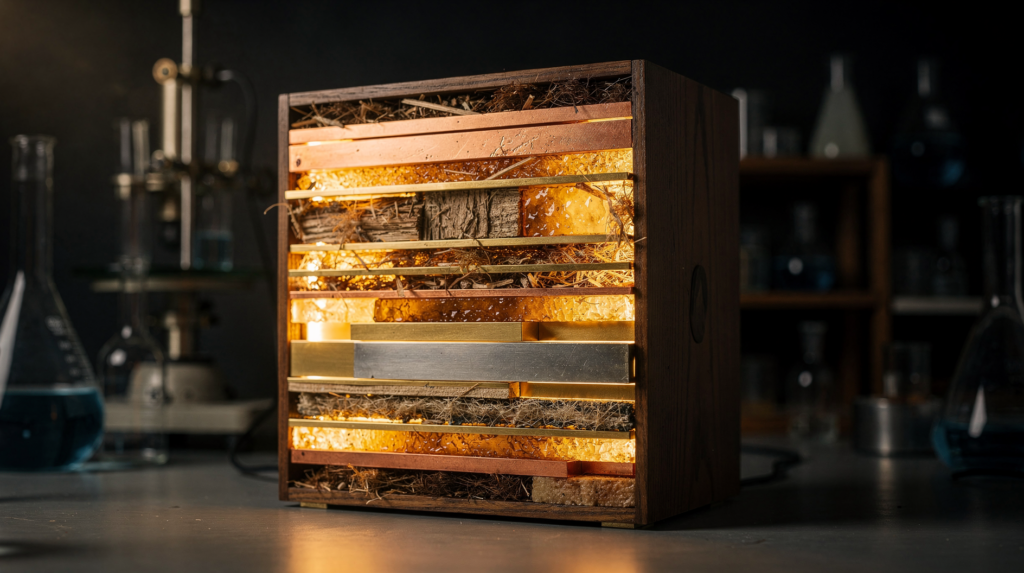
The orgone accumulator is one of Wilhelm Reich’s most significant inventions — a device designed to collect and concentrate ambient orgone energy. Despite being developed in the 1940s, it remains a point of reference for anyone researching orgone energy, and understanding it is essential for understanding how orgonite — its modern successor — came to exist.
What Is an Orgone Accumulator?
An orgone accumulator is a device made of alternating layers of organic and metallic materials. According to Reich’s model, organic materials (wood, cotton, wool) attract orgone energy from the surrounding environment, while metallic materials (steel wool, sheet metal) reflect and concentrate it inward. The more layers the accumulator contains, the stronger its supposed concentrating effect.
Reich built several types of accumulators: full-sized cabinets large enough for a person to sit inside, smaller blankets made of layered materials, shooter tubes for localised application, and devices for charging water. All followed the same fundamental principle of alternating organic and metallic layers.
How Did Reich Use the Orgone Accumulator?
Reich used accumulator cabinets in experimental sessions with patients, believing that sitting inside a concentrated field of orgone energy could support the body’s natural healing processes. He documented what he described as observable effects — increased skin temperature, heightened sensory awareness, and changes in mood — in people who used the accumulator regularly.
His claims attracted intense scientific and regulatory scrutiny. The US Food and Drug Administration prosecuted Reich in the 1950s, ordering the destruction of his accumulators and the burning of his books — one of the most controversial episodes in the history of American scientific regulation.
The DOR Problem: The Accumulator’s Main Limitation
Reich identified a serious limitation of the accumulator: its inability to distinguish between healthy orgone energy (OR) and what he called Deadly Orgone Radiation (DOR) — stagnant, blocked, or environmentally contaminated orgone. If DOR was present in the atmosphere — near nuclear facilities, areas of heavy electromagnetic pollution, or regions of environmental stress — the accumulator would concentrate it along with healthy OR, potentially creating a harmful environment rather than a beneficial one.
This DOR problem was one of the primary motivations behind Karl Hans Welz’s development of orgonite in the 1990s — a material designed to convert DOR into OR rather than simply accumulating whatever was present.
Orgone Accumulator vs Orgonite: The Key Difference
The orgone accumulator is a passive collector — it gathers and concentrates existing orgone energy without transforming it. Orgonite, by contrast, is an active converter — it continuously transforms stagnant or negative energy into a neutral, usable form through the piezoelectric activity of quartz crystal within a resin-metal matrix.
In today’s world of WiFi networks, mobile phones, smart meters, and ubiquitous electromagnetic pollution, the orgonite model is considered more practical and safer than the traditional accumulator for everyday use.
Can You Still Build an Orgone Accumulator?
Yes. Plans for building orgone accumulators are widely available, and a small community of Reich researchers continues to build and study them. A basic accumulator blanket — layers of wool and steel wool sewn together — is one of the simplest orgone devices anyone can make. For serious study of Reich’s original methods, building an accumulator is a meaningful and instructive project.
Learn More
- Orgone Accumulator vs Orgonite: What’s the Difference?
- Orgone Accumulator: Complete Guide
- Wilhelm Reich: The Man Behind Orgone Energy
- What Is Orgonite and How Does It Work?