
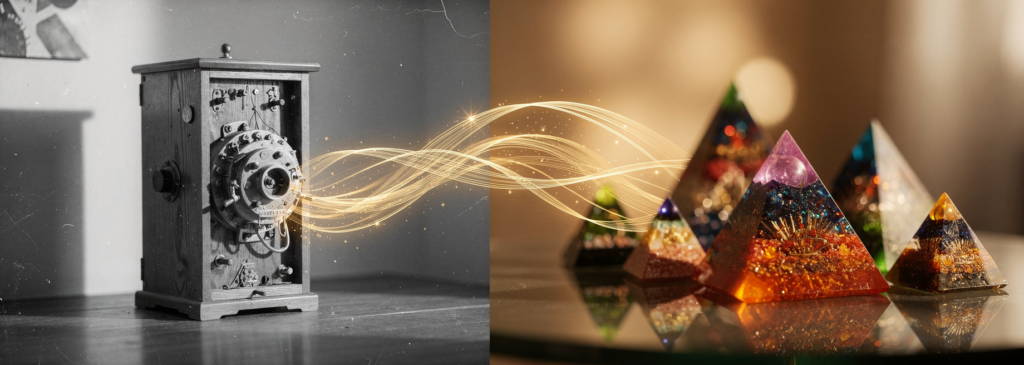
If you have spent any time exploring orgone energy, you have probably come across two terms that are often confused: the orgone accumulator and orgonite. They sound similar, they share the same theoretical foundation, and both are used for working with orgone energy — but they are fundamentally different devices with different designs, different behaviours, and different histories.
This article breaks down exactly what each one is, how they work, and which might be right for you.
What Is an Orgone Accumulator? Understanding Reich’s Original Device
The orgone accumulator was developed by Wilhelm Reich in the 1940s as a device designed to collect and concentrate ambient orgone energy. Unlike most objects, which Reich believed either attracted or repelled orgone, the accumulator was engineered to do both — drawing it in from the environment and holding it inside.
A traditional orgone accumulator consists of alternating layers of organic and metallic materials. The organic layer (typically wood or cotton) attracts orgone energy, while the metallic layer (steel wool or sheet metal) reflects and concentrates it inward. The more layers, the stronger the supposed accumulating effect.
How Reich Used the Orgone Accumulator
Reich built full-sized accumulator cabinets — sometimes called “orgone boxes” — large enough for a person to sit inside. He used them in experimental sessions with patients, believing that concentrated orgone energy could support the body’s natural healing processes. His work attracted intense controversy and eventually led to his prosecution by the US Food and Drug Administration in the 1950s.
Smaller versions were also built: blankets made from alternating organic and metallic layers, shooter tubes for localised application, and even orgone-charged water containers. All followed the same layering principle.
The DOR Problem
Reich also identified what he called DOR — Deadly Orgone Radiation: stagnant, blocked, or polluted orgone energy that he believed could accumulate inside the device under certain conditions, particularly near sources of nuclear radiation or electromagnetic pollution. This was a serious concern with the accumulator design — if DOR was present in the environment, the device could concentrate it along with healthy orgone.
This limitation would later become one of the main motivations behind Karl Hans Welz’s development of orgonite.
What Is Orgonite? Welz’s Active Solution
Orgonite was invented by Karl Hans Welz in the 1990s. Rather than simply collecting and holding orgone energy the way Reich’s accumulator did, Welz designed orgonite to continuously convert stagnant or negative energy into a neutral, usable form.
The key ingredient is the combination of metal shavings and resin in a fixed matrix. As the resin cures, it contracts around the metal particles, creating constant pressure. This, combined with the presence of quartz crystal, produces a continuous piezoelectric effect that Welz and later researchers believe drives the conversion process.
The result is a material that does not simply accumulate orgone energy passively — it actively processes it, eliminating the DOR risk that was inherent to Reich’s original design.
Orgone Accumulator vs Orgonite: Key Differences
| Feature | Orgone Accumulator | Orgonite |
|---|---|---|
| Invented by | Wilhelm Reich (1940s) | Karl Hans Welz (1990s) |
| Materials | Alternating organic + metallic layers | Metal shavings + resin + quartz crystal |
| Behaviour | Collects and holds orgone energy | Converts and radiates orgone energy |
| DOR risk | Yes — can accumulate negative energy | Minimal — designed to transmute it |
| Size | Typically large (cabinet, blanket) | Any size — pyramid, pendant, disc |
| Construction | Layered structure | Resin casting with embedded matrix |
| Modern use | Specialist research, niche interest | Widespread, easy to make or buy |
Which One Should You Use?
For most people interested in working with orgone energy today, orgonite is the practical choice. It is widely available, comes in many forms — pyramids, pendants, tower busters — and does not require the controlled environment that Reich recommended for accumulator use.
The orgone accumulator remains of interest to researchers and serious students of Reich’s original work. If you want to study Reich’s methods as he intended them, building or purchasing a traditional accumulator is a meaningful step. But if your goal is EMF protection, general energy work, or simply introducing orgone devices into your home or daily life, orgonite is the more accessible and versatile starting point.
The Line from Reich to Welz
It is worth noting that Karl Hans Welz did not reject Reich’s work — he built on it. The orgone accumulator established the foundational principle that certain material combinations interact with orgone energy in measurable ways. Welz took that principle and redesigned it for a world full of electromagnetic pollution, nuclear radiation, and modern environmental stressors that Reich could not have anticipated in the 1940s.
Understanding both devices gives you a much clearer picture of how orgone energy research has evolved — from Reich’s pioneering laboratory work to the practical, castable material that millions of people use today.
Learn More
If you want to go deeper into either device, these articles cover the key concepts in more detail:
- Wilhelm Reich: The Man Behind Orgone Energy
- What Is Orgonite and How Does It Work?
- Who Was Karl Hans Welz? The Man Who Invented Orgonite
- Chi Generator: What It Is and How It Works