
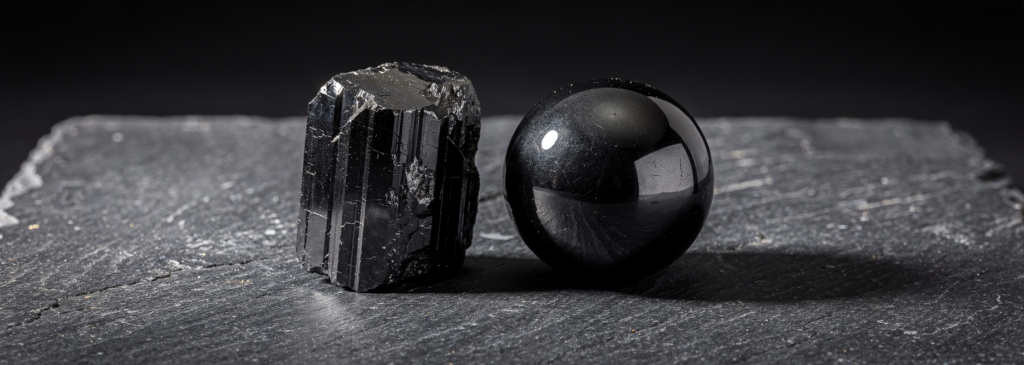
Black tourmaline and shungite are the two most popular minerals for EMF protection and energy work. Both appear in orgonite, both are sold as standalone protection tools, and both have passionate communities behind them. But they are very different materials with different compositions, different properties, and different applications. This guide gives you the complete comparison.
What Is Black Tourmaline?
Black tourmaline — also known as schorl — is a boron silicate mineral found in granite and metamorphic rocks worldwide. It is one of the most electrically active minerals in the natural world. When compressed or heated, black tourmaline generates a measurable electric charge through the piezoelectric and pyroelectric effects. This electrical activity is the foundation of its use in orgonite and energy work: the crystal responds to physical pressure by producing a small but consistent electrical field.
Black tourmaline also generates negative ions naturally, which researchers have associated with air quality improvement and reduction of the effects of positive ion environments — the kind created by electronic devices, air conditioning, and urban environments. It is consistently among the highest-rated minerals for inclusion in orgonite, alongside quartz. Our full guide to crystals used in orgonite covers the complete list.
What Is Shungite?
Shungite is a carbon-based mineraloid found almost exclusively in the Karelia region of Russia, near the village of Shunga from which it takes its name. It is estimated to be approximately two billion years old, making it one of the oldest carbon-containing formations on Earth. What makes shungite unique is its molecular structure: it contains fullerenes — hollow carbon molecules also known as C60 or buckyballs — that give it unusual electrical and chemical properties not found in most other minerals.
Shungite is electrically conductive — a property rare among stones — and has been studied for its ability to absorb and neutralise a wide range of organic compounds and contaminants. Russian researchers have investigated its use in water purification for decades. In the context of orgonite and EMF protection, shungite is valued both as a standalone device and as an inclusion in the orgonite matrix, where its conductivity contributes to the organic-metallic interaction. See our dedicated guide on shungite and orgone energy for the full technical context.
Black Tourmaline vs Shungite: Direct Comparison
| Feature | Black Tourmaline | Shungite |
|---|---|---|
| Composition | Boron silicate mineral (schorl) | Carbon mineraloid with fullerenes (C60) |
| Origin | Worldwide (Brazil, Africa, USA) | Almost exclusively Karelia, Russia |
| Electrical properties | Piezoelectric + pyroelectric | Electrically conductive |
| Negative ion emission | Yes — strong | Moderate |
| EMF interaction | Absorbs and transforms | Absorbs and filters |
| Water purification | Limited | Yes — documented research |
| Use in orgonite | Core ingredient — widely used | Excellent inclusion — growing use |
| Standalone device | Effective as raw stone or pendant | Effective as pyramid, plate or pendant |
| Price | Moderate | Moderate to high (authentic Russian) |
Which Is Better for EMF Protection?
Neither mineral is objectively superior for EMF protection — they work through different mechanisms and complement each other well. Black tourmaline interacts with electromagnetic fields through its piezoelectric properties, generating an opposing electrical charge that disrupts and transforms the field. Shungite works primarily through its carbon structure and conductivity, absorbing and dispersing electromagnetic radiation rather than transforming it.
The most effective orgonite pieces typically include both minerals alongside quartz. The quartz amplifies the piezoelectric effect of the tourmaline while the shungite adds a conductive element to the matrix. This combination — shungite, black tourmaline, and quartz in a resin matrix — is the formula most consistent with Karl Hans Welz’s original specification for high-density orgonite. Our pieces at Orgonitum follow this formula precisely.
Which Is Better for Energy Work?
Black tourmaline has a long history in crystal healing traditions as a protective stone — specifically for grounding and shielding against negative energy. Its electrical activity makes it one of the most dynamically active minerals in an energetic context: it responds to the environment around it rather than sitting passively.
Shungite is considered more of a purifying and balancing mineral in energy work traditions. The fullerene structure is thought to act as a molecular filter, removing disruptive frequencies rather than actively transforming them. Users often describe shungite as having a calmer, more neutral energy compared to the more assertive presence of black tourmaline.
For a thorough comparison of their individual properties, see our dedicated articles: Shungite and Orgone Energy and Crystals in Orgonite.
How to Use Both Together
- In orgonite: include both in the matrix alongside quartz for maximum energetic activity and EMF interaction
- As standalone stones: place black tourmaline near electronic devices for active protection; use shungite near water sources or as a surface plate under devices
- As pendants: both are widely available as wearable devices — black tourmaline for active shielding, shungite for continuous passive filtration
- Water charging: shungite is specifically used to charge and purify drinking water — place authentic shungite stones in a glass jug of water for several hours
A Note on Authenticity
Shungite is heavily counterfeited. Authentic shungite from Karelia is electrically conductive — you can test it with a simple conductivity tester or a multimeter. If a stone sold as shungite does not conduct electricity, it is not genuine. When buying orgonite that includes shungite, verify that the seller specifies the source and grade. Type I (elite) shungite has the highest fullerene content; Type II and III are more commonly used in orgonite due to their availability and price.
Related Articles
- Shungite and Orgone Energy: A Powerful Combination?
- Crystals in Orgonite: Which Ones and Why
- EMF Protection with Orgonite: What the Research Says
- What is Orgonite and How Does It Work?
Looking for orgonite for EMF protection?
How to choose an orgonite piece →
Hello,
I would like to know where to purchase both of these items in Australia.
Pyramids or pendants
Cheers