
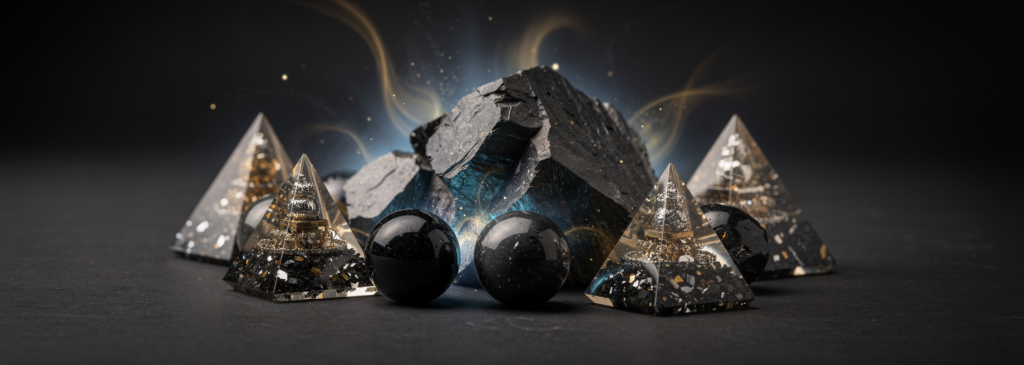
Among the minerals that have gained a reputation in the world of orgone energy research, shungite stands out as one of the most distinctive. It is one of the very few natural materials that combines high electrical conductivity with an organic carbon-based structure — a combination that makes it particularly interesting when examined through the lens of Wilhelm Reich’s and Karl Hans Welz’s work.
This article looks at what shungite is, why it has attracted attention in orgone energy circles, and why shungite orgonite has become one of the most popular combinations in energy work today.
What Is Shungite?
Shungite is a carbon-rich mineral found almost exclusively in the Karelia region of Russia, near the village of Shunga — from which it takes its name. Deposits are estimated to be around two billion years old, predating most complex life on Earth. Its carbon content ranges from roughly 30% in regular shungite to up to 98% in the rarest form, known as elite or Type I shungite.
What makes shungite scientifically unusual is the presence of fullerenes — hollow carbon molecules first discovered in the 1980s and awarded the Nobel Prize in Chemistry in 1996. Shungite is one of the only natural sources of fullerenes known to exist, and their presence is thought to underpin many of the mineral’s reported properties.
Types of Shungite
There are three main types used in energy work and orgonite:
- Elite (Type I) shungite — up to 98% carbon, silvery and brittle, the most powerful but most expensive and fragile
- Petrovsky (Type II) shungite — around 50–70% carbon, more stable, used in chips and pendants
- Regular (Type III) shungite — 30–50% carbon, most widely available, commonly used in powder form for orgonite casting
Shungite and Orgone Energy: The Connection
Reich’s model of orgone energy identified certain materials as particularly effective at attracting and interacting with life force energy — primarily organic substances and specific minerals. Shungite, with its ancient carbon matrix and unusual electrical properties, fits several of Reich’s criteria in ways that most common minerals do not.
Within the orgone energy community, shungite is primarily valued for two reported properties: its interaction with electromagnetic fields (EMF) and its ability to work synergistically within an orgonite matrix. While mainstream science does not validate orgone theory, shungite’s demonstrated electrical conductivity and fullerene content give it a material basis for the claims made about it — something that sets it apart from many crystals used in energy work.
Shungite and Orgonite: A Powerful Combination
When shungite and orgonite are combined in a single piece, the result draws on the distinct properties of both materials. Shungite contributes its high carbon content and natural EMF-interacting characteristics, while the resin-metal matrix of orgonite provides the continuous energy conversion framework developed by Karl Hans Welz.
In practice, shungite orgonite pieces typically use crushed or powdered shungite as a primary mineral component, often alongside quartz crystal to amplify the piezoelectric effect. The shungite replaces or supplements the metal shavings traditionally used in orgonite, adding a secondary layer of mineral-based EMF interaction.
Why Orgonite Makers Choose Shungite
Shungite is one of the few minerals that combines high electrical conductivity with a carbon-based organic structure — two properties that make it well-suited to the orgonite matrix. Among DIY orgonite makers, shungite has become one of the most popular additions precisely because it addresses EMF concerns directly. While quartz crystal remains the standard foundation of most orgonite recipes, shungite orgonite has carved out a distinct category for people whose primary interest is reducing exposure to wireless radiation and electrosmog.
Which Type of Shungite Works Best in Orgonite?
Elite (Type I) shungite contains the highest carbon content but its irregular shape makes it difficult to mix into resin. Most orgonite makers use regular or petrovsky shungite in powder or chip form, which integrates cleanly into the casting process. For pendants and small pieces, a single elite shungite stone set into the resin is a common and visually striking approach.
Shungite for EMF Protection: What Is the Evidence?
Shungite is frequently marketed for EMF protection, and several studies have examined its electrical and absorptive properties. Research published in peer-reviewed journals has confirmed shungite’s ability to absorb and attenuate certain frequencies of electromagnetic radiation — a property linked to its fullerene content and high carbon conductivity.
However, it is important to be precise about what this means in practice. A shungite stone placed near a WiFi router or phone is unlikely to create a measurable reduction in your exposure to EMF at a distance. The mineral’s absorptive properties are real but scale-dependent. Where shungite shows more consistent results is when used in direct contact with the body — as a pendant, bracelet, or phone plate — or when incorporated into orgonite pieces placed close to EMF sources.
How to Use Shungite with Orgone Energy
There are several practical ways to work with shungite in an orgone energy context:
- Shungite orgonite pyramids — cast with shungite powder and quartz, placed near routers, smart meters, or computer workstations
- Shungite pendants — worn directly on the body; elite shungite pieces are particularly popular for this use
- Shungite phone plates — thin discs adhered to the back of a phone, one of the most common shungite products on the market
- Shungite water — placing raw shungite stones in water for several hours; a practice with roots in traditional Russian use of the mineral
- Tower busters with shungite — small orgonite pieces incorporating shungite, buried or placed near cell towers and electrical infrastructure
Shungite vs Other Minerals in Orgonite
Shungite is not the only mineral used in orgonite, and it is worth understanding how it compares to the other common options:
- Quartz crystal — the standard foundation of all orgonite; provides piezoelectric amplification. Works with shungite rather than instead of it.
- Black tourmaline — another popular EMF mineral, also electrically conductive. Often used alongside shungite. See the full comparison of black tourmaline vs shungite.
- Amethyst — valued for its frequency and colour; less relevant to EMF specifically.
- Selenite — a soft mineral, rarely used in cast orgonite but sometimes layered on top of finished pieces.
For EMF-focused orgonite, the most effective combination most makers have settled on is shungite + black tourmaline + quartz, with metal shavings as the base matrix.
Where to Source Quality Shungite
The shungite market has a significant counterfeit problem. Because the mineral is only found in one region of Russia, supply is limited — but demand has grown substantially, and many products sold as shungite are ordinary black stone with no meaningful carbon content.
A simple test: genuine shungite conducts electricity. Touch both leads of a simple continuity tester to a piece of shungite — if it conducts, it is real. Elite shungite in particular is very conductive and easy to verify this way. Regular shungite may show lower conductivity depending on the carbon percentage.
For orgonite casting, buy shungite powder or chips from suppliers who provide origin documentation (Karelia, Russia) and ideally third-party mineral analysis. Etsy has reputable shungite sellers, but apply the same scrutiny you would to any mineral purchase.
Learn More
If you want to explore the minerals and devices that work alongside shungite in orgone energy research, these articles go deeper:
- Black Tourmaline vs Shungite: Which Is Better for EMF Protection?
- Crystals in Orgonite: Which Ones and Why
- EMF Protection with Orgonite: What the Research Says
- How to Make Orgonite at Home: Beginner’s Guide
- What Is Orgonite and How Does It Work?
Looking for orgonite for EMF protection?
How to choose an orgonite piece →