
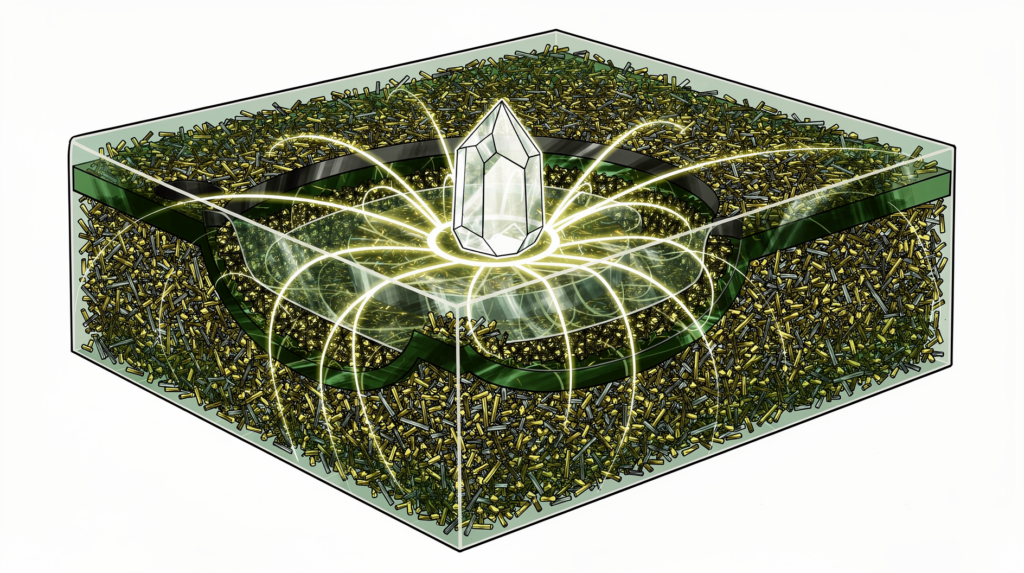
Understanding the properties of orgonite means understanding both its physical composition and the theoretical framework that explains why its components interact the way they do. This article covers both — the material science of what orgonite is made from, and the orgone energy model that explains what it is intended to do.
Physical Composition of Orgonite
Orgonite is a composite material invented by Karl Hans Welz in the 1990s. In its most basic form it contains three components:
- Metal shavings — copper, aluminium, steel, or a combination. The metal provides the conductive element of the matrix.
- Resin — typically polyester or epoxy casting resin. The resin binds the matrix and, crucially, contracts permanently around the metal and crystal as it cures.
- Quartz crystal — a point or chips embedded in the resin. Quartz is piezoelectric — it generates a small electrical charge under mechanical pressure.
The Piezoelectric Effect in Orgonite
The key physical property that makes orgonite theoretically distinct from other resin-metal composites is the piezoelectric effect. As polyester or epoxy resin cures, it undergoes a permanent contraction — it shrinks slightly as it hardens. Because the quartz crystal is embedded in the resin, this contraction creates continuous mechanical pressure on the crystal.
Quartz under sustained mechanical pressure produces a sustained electrical charge — a sustained piezoelectric effect. Welz believed this continuous electrical activity was the mechanism driving orgonite’s conversion of DOR (stagnant orgone) into OR (usable orgone energy).
The Role of Metal in Orgonite
Metal shavings serve two functions in the orgonite matrix. First, they provide a conductive medium that interacts with electromagnetic fields in the environment. Second, they create the physical matrix through which the resin contracts — without the irregular surfaces of the metal shavings, the resin would not exert the same pressure on the crystal.
Copper is the most valued metal for orgonite because of its high electrical conductivity and its traditional associations with energy work. Aluminium is widely used because it is inexpensive and effective. Steel wool provides very fine shavings that create a dense matrix.
Additional Properties from Optional Components
Many orgonite makers add further components to enhance specific properties:
- Black tourmaline — adds piezoelectric and pyroelectric properties, negative ion generation
- Shungite — adds high carbon conductivity and fullerene-based EMF interaction
- Amethyst — adds violet quartz properties, associated with calm and clarity
- Sacred geometry inserts — copper coils, Fibonacci spirals — believed to enhance energetic coherence
What Orgonite Is Not
Orgonite is not a Faraday cage and does not block electromagnetic radiation in the way a metallic enclosure does. It is not a medical device and makes no clinically proven health claims. It is a material whose properties — piezoelectric activity, conductive matrix, mineral composition — are physically real, but whose specific claimed effects on orgone energy remain outside the scope of mainstream scientific validation.
Learn More
- What Is Orgonite and How Does It Work?
- Orgonite Materials: What Goes Inside and Why
- How to Make Orgonite at Home: Beginner’s Guide
- Crystals in Orgonite: Which Ones and Why