
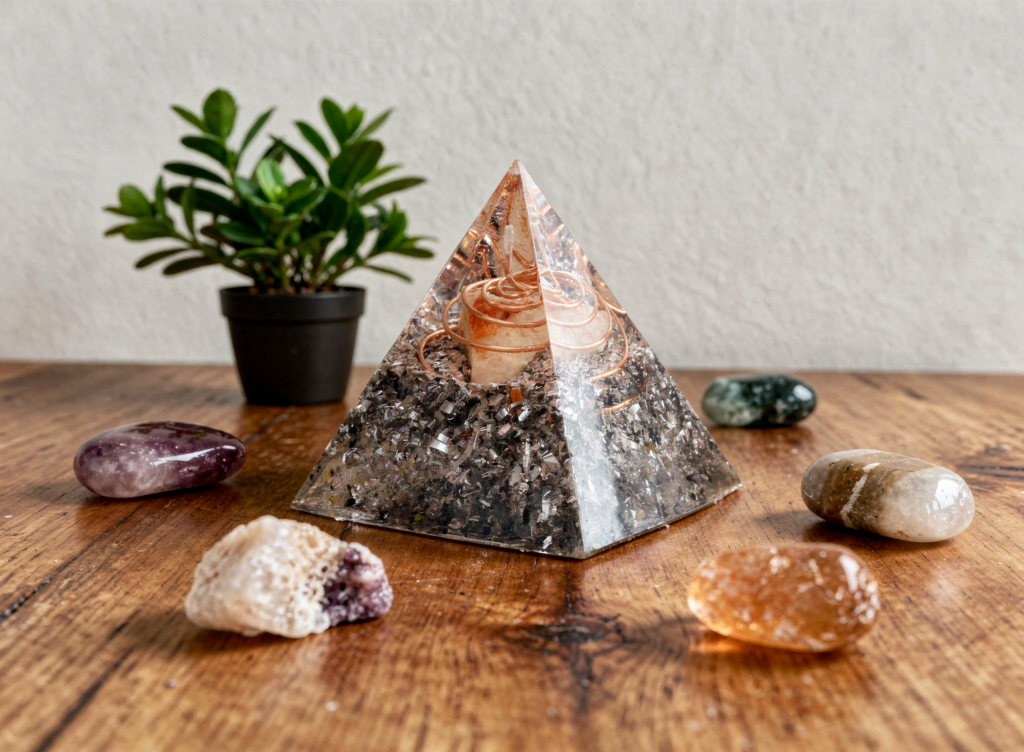
If you’ve ever wondered what makes orgonite work — or why some pieces seem more effective than others — the answer comes down to materials. Orgonite is not simply resin poured into a mould. It is a specific combination of substances chosen for their physical and energetic properties. This guide covers each component, why it is used, and what to look for when evaluating quality.
The Three Core Components
Every genuine orgonite piece, as defined by Karl Hans Welz who invented the material in 1992, contains three essential elements: an organic matrix, an inorganic component, and a quartz crystal. Each plays a distinct role. Remove any one of them and the result is no longer orgonite in the technical sense — it is simply a decorative resin object.
The Organic Matrix: Resin
The organic component in orgonite is typically polyester or epoxy resin. Resin serves as the binding matrix that holds all other materials in suspension. From an energetic perspective, organic materials are said to attract and hold orgone energy — a property Wilhelm Reich identified in his original accumulator research.
Polyester resin is the most common choice because it shrinks slightly as it cures. This shrinkage is important: it creates mechanical pressure on the quartz crystal inside, activating its piezoelectric properties. Epoxy resin shrinks less and produces less piezoelectric pressure on the crystal. The quality of the resin matters — low-grade resins with excessive additives may not transmit pressure as effectively.
The Inorganic Component: Metal Shavings
The metal component is what most clearly distinguishes genuine orgonite from imitation pieces. Reich’s research established that inorganic materials — particularly metals — repel orgone energy, while organic materials attract it. By alternating layers of organic and inorganic material, an accumulator effect is created.
In orgonite, this alternation happens at a microscopic level throughout the entire piece. Metal shavings distributed evenly through the resin create thousands of tiny organic/inorganic boundaries within a single object. Aluminium shavings are the most common — lightweight and widely available. Copper is also popular and considered by many practitioners to enhance energetic conductivity. Steel, brass and bronze are used in some pieces.
What Metal Content Actually Means
The ratio of metal to resin is critical. A common mistake in commercially produced pieces is to use insufficient metal. A handful of metal powder at the bottom of a mould does not create the layered matrix that makes orgonite function. The shavings must be distributed throughout the entire volume of resin.
Genuine high-density orgonite should feel noticeably heavy for its size. Metal powder is less effective than shavings — powder particles form a continuous metallic layer rather than creating discrete boundaries with the resin. Shavings of varying sizes create more complex and active boundaries throughout the matrix.
The Crystal Component: Quartz
Quartz is the third essential component of orgonite and was Karl Hans Welz’s key innovation beyond Reich’s original accumulator design. Quartz is piezoelectric — when subjected to mechanical pressure, it generates a small but measurable electrical charge. As the resin cures and contracts around the crystal, it applies sustained pressure, activating this effect continuously.
Clear quartz is the standard choice. Other crystals are added for specific purposes: black tourmaline for grounding and EMF-related applications, amethyst for calming environments, shungite for its carbon-based properties and reported EMF interaction. These additions are secondary — the foundation always remains resin, metal shavings and quartz in the correct proportions.
Additional Materials
Beyond the three core components, many orgonite makers include copper coils or spirals. A copper spiral encapsulated in the resin is said to create a vortex effect that enhances the movement of orgone energy through the piece. Welz himself used coil configurations in his Chi Generator devices. Other common additions include selenite, shungite, iron oxide powder, and various crystals chosen for their reported energetic qualities such as amethyst, citrine or tourmaline.
How to Evaluate Quality
When assessing any orgonite piece, these are the practical indicators of genuine construction:
- Weight: a properly made piece should feel dense and heavy relative to its size.
- Metal distribution: visible metal shavings throughout the piece, not just at the base or surface.
- Crystal presence: at least one quartz crystal, ideally pointing toward the apex in pyramidal forms.
- Shavings not powder: genuine metal shavings create visible texture in the resin. Metallic powder produces a uniform shimmer and is less effective.
- Maker transparency: reputable makers describe their formula — the type of resin, the metals used, the crystal varieties.
Related articles: What is Orgonite and How Does It Work? — Crystals in Orgonite: Which Ones and Why — Does Orgonite Really Work? An Honest Review