
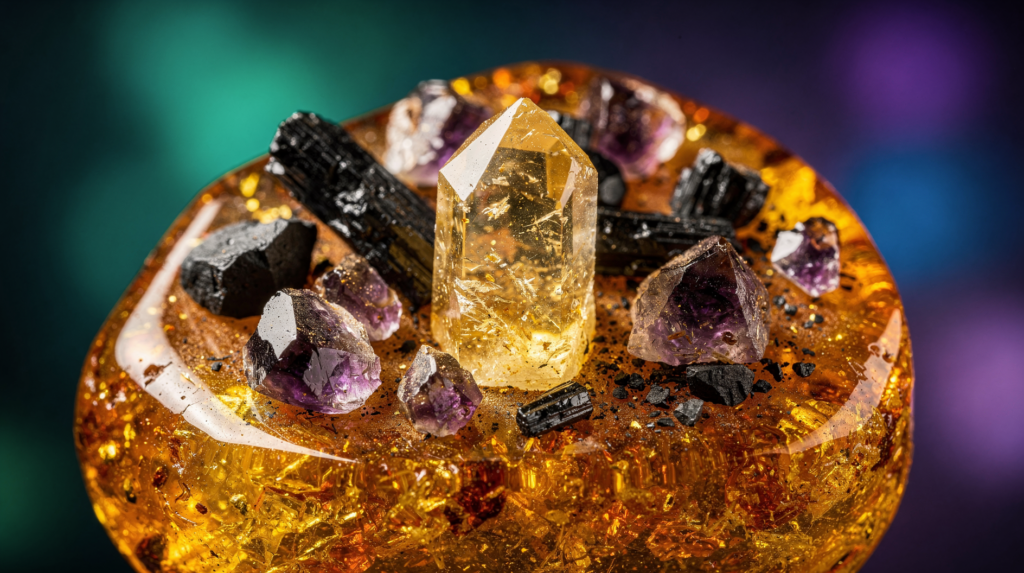
One of the most common questions from people new to orgonite is: why does it contain crystals, and does the type of crystal matter? The answer is yes — each crystal used in orgonite has specific properties that influence the device’s behaviour. Understanding orgonite crystal meaning helps you choose pieces aligned with your specific intentions or needs.
Why Crystals Are Essential in Orgonite
Crystals are not decorative additions to orgonite — they are functional components. Karl Hans Welz’s original orgonite formula centred on quartz crystal because of its piezoelectric properties: quartz generates a small electrical charge when compressed, and the resin in orgonite contracts permanently around the crystal as it cures, creating continuous mechanical pressure. This produces a sustained piezoelectric effect that Welz believed was central to orgonite’s energy conversion process.
Additional crystals beyond quartz are chosen for their specific mineral properties, their reported energetic qualities, or both.
Quartz Crystal — The Foundation
Clear quartz is the standard foundation of all orgonite. Its piezoelectric properties make it the primary driver of the conversion process. A quartz point oriented with the tip toward the apex of a pyramid is the most common configuration. Quartz is also valued for its supposed amplifying effect — it is believed to enhance the properties of other crystals placed alongside it.
Black Tourmaline — EMF Protection
Black tourmaline is one of the most popular secondary crystals in orgonite, particularly in pieces intended for EMF protection. It is piezoelectric and pyroelectric, generates negative ions continuously, and is believed to create a protective energetic field around the device. Tourmaline chips or points are typically embedded in the resin alongside quartz.
Shungite — Carbon-Based EMF Interaction
Shungite’s high carbon content and fullerene structure give it genuine electrical conductivity and EMF-absorbing properties. In orgonite, shungite powder or chips are mixed into the resin, sometimes replacing metal shavings as the conductive element. Shungite orgonite is particularly popular among people focused on wireless radiation from phones, routers, and smart meters.
Amethyst — Calming and Clarity
Amethyst is a violet variety of quartz with the same piezoelectric properties as clear quartz. It is traditionally associated with calm, mental clarity, and stress reduction. In orgonite, amethyst is often used in pieces intended for meditation spaces, bedrooms, or areas where mental focus is valued.
Selenite — Cleansing
Selenite is soft and cannot be mixed into resin, but it is sometimes layered on top of finished orgonite pieces. It is associated with cleansing and amplifying other crystals’ properties. Its use in orgonite is more supplementary than structural.
Citrine — Energy and Abundance
Citrine is a yellow variety of quartz associated with energy, positivity, and abundance in traditional crystal work. It shares quartz’s piezoelectric properties and is a functional addition to orgonite as well as a meaningful one for those who work with crystal intentions.
How to Choose
For EMF protection: quartz + black tourmaline + shungite is the most widely used combination. For general energy work: quartz alone or with amethyst. For meditation: amethyst or clear quartz point with a clean resin cast. The most important factor is always the quality of the orgonite base — metal shavings, resin, and quartz — regardless of which additional crystals are included.
Learn More
- Crystals in Orgonite: Which Ones and Why
- Shungite and Orgone Energy: A Powerful Combination?
- Black Tourmaline vs Shungite: Which is Better for EMF?
- Orgonite Pyramid: Benefits, Uses and How to Choose One