
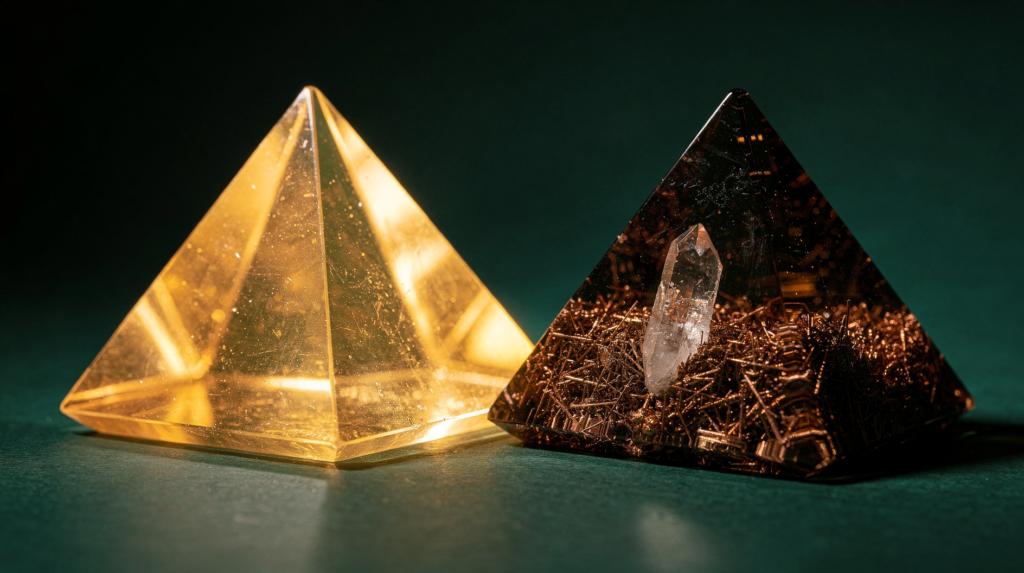
The terms orgone pyramid and orgonite pyramid are often used interchangeably, but they refer to two distinct objects with different materials, different histories, and different intended functions. If you are researching either one, understanding the difference will help you make a more informed decision about what you are actually looking at.
What Is an Orgone Pyramid?
An orgone pyramid refers to any pyramid-shaped object associated with orgone energy — the life force energy first described by Wilhelm Reich in the 1930s and 1940s. In Reich’s original framework, orgone energy was a physical, measurable force present throughout the atmosphere and in all living organisms. Reich never built pyramids specifically, but the pyramid shape became associated with orgone work because of its geometric properties and its historical links to energy concentration in alternative research circles.
Today, the term orgone pyramid is used loosely to describe any pyramid that is believed to interact with orgone energy — whether or not it contains the specific materials that define orgonite.
What Is an Orgonite Pyramid?
An orgonite pyramid is a specific type of orgone device invented by Karl Hans Welz in the 1990s. Welz developed orgonite as a material — a combination of metal shavings, resin, and quartz crystal — that he believed could continuously convert stagnant or negative orgone energy (DOR) into a neutral, usable form (OR). The pyramid shape is one of the most popular forms for casting orgonite, but the shape itself is secondary to the material composition.
A genuine orgonite pyramid contains three essential components: metal shavings (copper, aluminium, or steel), resin (typically polyester or epoxy), and at least one quartz crystal point oriented with the tip pointing upward toward the apex. The resin contracts around the metal as it cures, creating a piezoelectric effect that Welz believed drove the energy conversion process.
Key Differences at a Glance
| Feature | Orgone Pyramid | Orgonite Pyramid |
|---|---|---|
| Origin | Loosely associated with Reich’s work | Invented by Karl Hans Welz (1990s) |
| Materials | Variable — may be crystal, wood, copper | Metal shavings + resin + quartz crystal |
| Function | Passive energy interaction | Active energy conversion (OR to DOR) |
| Standardisation | No fixed definition | Specific material formula |
| Availability | Wide range of types and sellers | Widely available, quality varies |
Which Should You Choose?
If your interest is in working with orgone energy as Welz defined it — with the active conversion of DOR to OR — then an orgonite pyramid is the more specific and technically grounded choice. Look for pieces that clearly describe the presence of metal shavings, resin, and quartz crystal. Pieces made only of crystal or copper without resin are not orgonite in the Welz sense, regardless of what they are called.
If your interest is broader — including sacred geometry, crystal energy, or general energy work — then the wider category of orgone pyramid may include objects that suit your needs, even if they do not strictly follow the Welz formula.
Learn More
- Orgonite Pyramid: Benefits, Uses and How to Choose One
- What Is Orgonite and How Does It Work?
- Who Was Karl Hans Welz? The Man Who Invented Orgonite
- Crystals in Orgonite: Which Ones and Why