
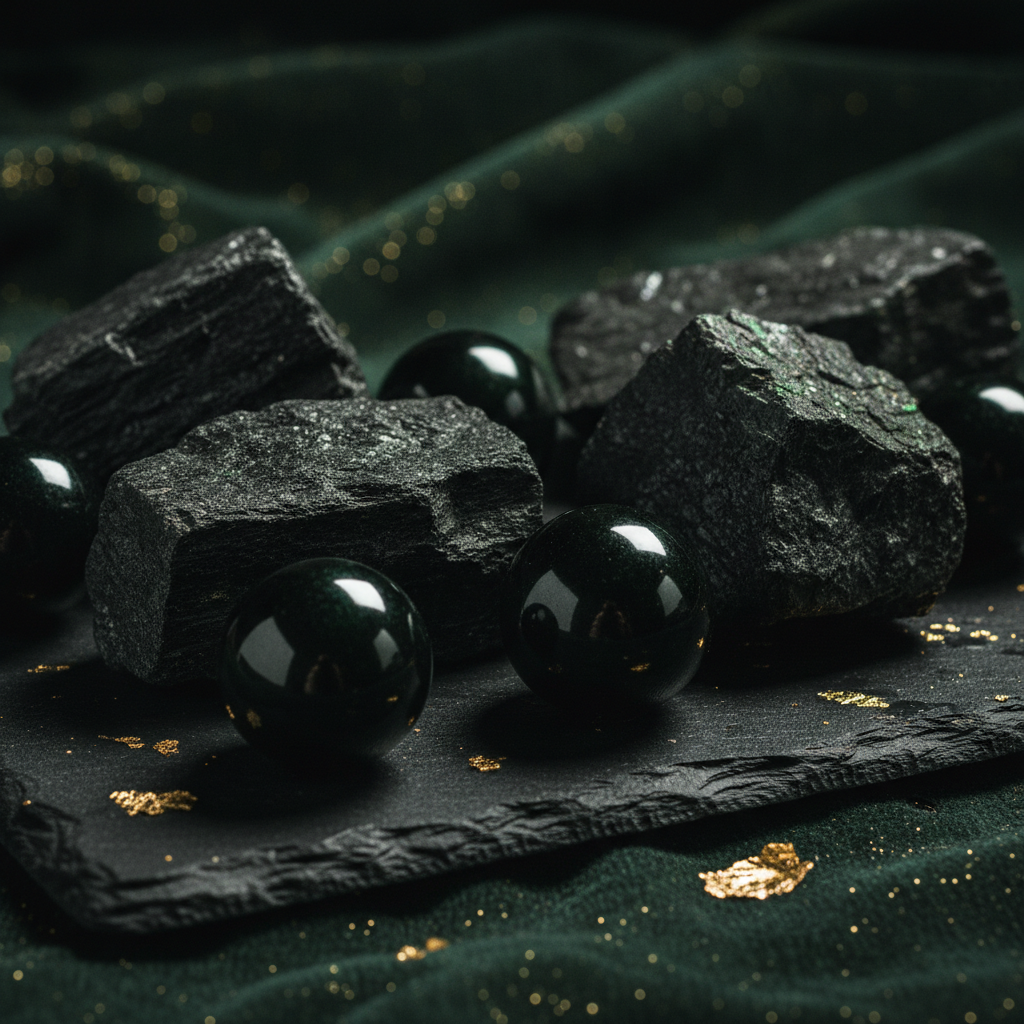
Shungite is a unique, ancient carbon-rich mineral primarily found in the Republic of Karelia, Russia. It is distinguished by its unusual composition, which includes naturally occurring fullerenes, a rare form of carbon. This guide explores its origins, types, properties, and various applications, including its role in orgone energy devices.
What is Shungite?
Shungite is a natural mineraloid composed primarily of carbon, originating from the ancient deposits in Karelia, Russia. Its unique structure includes fullerenes, a rare molecular form of carbon, setting it apart from other carbon-based minerals like graphite or diamond.
Shungite is estimated to be around two billion years old, predating the existence of plants and forests, which typically form carbon deposits. Its exact geological formation remains a subject of scientific interest, with theories ranging from the decomposition of ancient microorganisms to the impact of a large meteorite. The mineral is found in various forms, from dense, black rock to a lustrous, silver-black variety known as Elite or Noble Shungite.
The Unique Composition of Shungite: Fullerenes
Fullerenes are spherical or cylindrical carbon molecules, often referred to as ‘buckyballs,’ that are a key component of shungite. Their presence in this natural mineral is highly unusual and contributes to shungite’s distinct properties, according to various theories.
Discovered in 1985 by scientists who later received the Nobel Prize in Chemistry, fullerenes represent a third allotrope of carbon, alongside graphite and diamond. Their cage-like structure, typically C60 or C70, gives them unique physical and chemical characteristics. In shungite, these fullerenes are naturally integrated into the mineral matrix, distinguishing it from synthetic fullerene compounds. While the exact mechanism of their formation within shungite is still debated, their presence is a defining feature of the mineral.
Types of Shungite
Shungite is broadly categorized into several types based on its carbon content and appearance, with the primary distinctions being Elite (Noble), Petrovsky, and Regular (Black) shungite. These variations dictate their properties and suitability for different applications.
- Elite (Noble) Shungite: This is the purest and rarest form, containing typically 90-98% carbon. It has a shiny, semi-metallic luster and is very fragile. Due to its high carbon content and unique appearance, Elite shungite is often used for water purification and as decorative pieces. It is found in smaller quantities compared to other types.
- Petrovsky Shungite: With a carbon content ranging from 70-80%, Petrovsky shungite is less lustrous than Elite but more durable. It is named after Peter the Great, who reportedly used shungite for water purification in his spas. This type is often used for crafting larger objects and for water treatment.
- Regular (Black) Shungite: This is the most common type, containing 30-50% carbon. It has a matte, dull black appearance and is denser and more easily shaped than Elite shungite. Regular shungite is widely used for various applications, including orgonite components, pyramids, spheres, and other functional items.
- Shungite Rock: This refers to the shungite-bearing rock, which has a lower carbon content (typically less than 30%) and contains other minerals. It is often used as a building material or for large-scale environmental applications.
| Type of Shungite | Carbon Content | Appearance | Key Characteristics | Common Uses |
|---|---|---|---|---|
| Elite (Noble) | 90-98% | Shiny, semi-metallic | Rarest, most fragile, highest fullerene concentration | Water purification, high-end collectors |
| Petrovsky | 70-80% | Slightly lustrous | More durable than Elite, intermediate purity | Water treatment, larger objects |
| Regular (Black) | 30-50% | Matte black | Most common, denser, easily shaped | Orgonite, pyramids, spheres, general use |
Reported Uses and Applications of Shungite
Shungite is widely used for water purification, personal wellness, and as a component in devices aimed at interacting with electromagnetic fields (EMF). Its unique properties, attributed to its carbon structure and fullerenes, are central to these applications.
Water Purification
One of the most historically significant uses of shungite is for water purification. Users report that placing shungite in water can help filter impurities, balance its mineral composition, and improve its taste. This practice dates back centuries in Russia, where shungite-infused water was known for its purported beneficial qualities.
EMF Interaction
According to Welz’s framework and user reports, shungite is often incorporated into personal devices and orgonite for its perceived ability to interact with electromagnetic fields. While the precise mechanisms are not fully understood, it is theorized that shungite’s conductive properties and fullerene content may play a role in this interaction.
Personal Wellness and Accessories
Shungite is frequently crafted into jewelry, pyramids, spheres, and other objects for personal use. Users report a sense of energetic balance and protection when wearing or placing shungite objects in their environment.
Shungite in Orgonite Devices
In the context of orgonite, shungite is often included for its unique carbon structure and reported interaction with various energy fields, particularly electromagnetic frequencies. It is believed to complement the orgonite matrix in balancing ambient energy.
Karl Hans Welz’s work on orgone energy and orgonite devices emphasizes the importance of specific material combinations. In orgonite, shungite is typically combined with transparent casting resin and metal shavings. According to Welz’s theory, the interaction between the organic resin and inorganic metals creates a dynamic field that draws in and transmutes orgone energy. The addition of shungite, with its conductive properties and fullerene content, is believed by some users to enhance the device’s capacity to interact with and harmonize environmental energies, including those associated with EMF. Its inclusion is often seen as a way to broaden the energetic spectrum of the orgonite.
Related Reading
- Shungite and Orgone Energy
- Black Tourmaline vs. Shungite
- Crystals in Orgonite
- EMF Protection with Orgonite
Orgonite and orgone energy devices are presented as tools for energy balancing and spiritual wellness. They are not intended as replacements for medical treatment. Consult a qualified healthcare professional for any health-related decisions.