
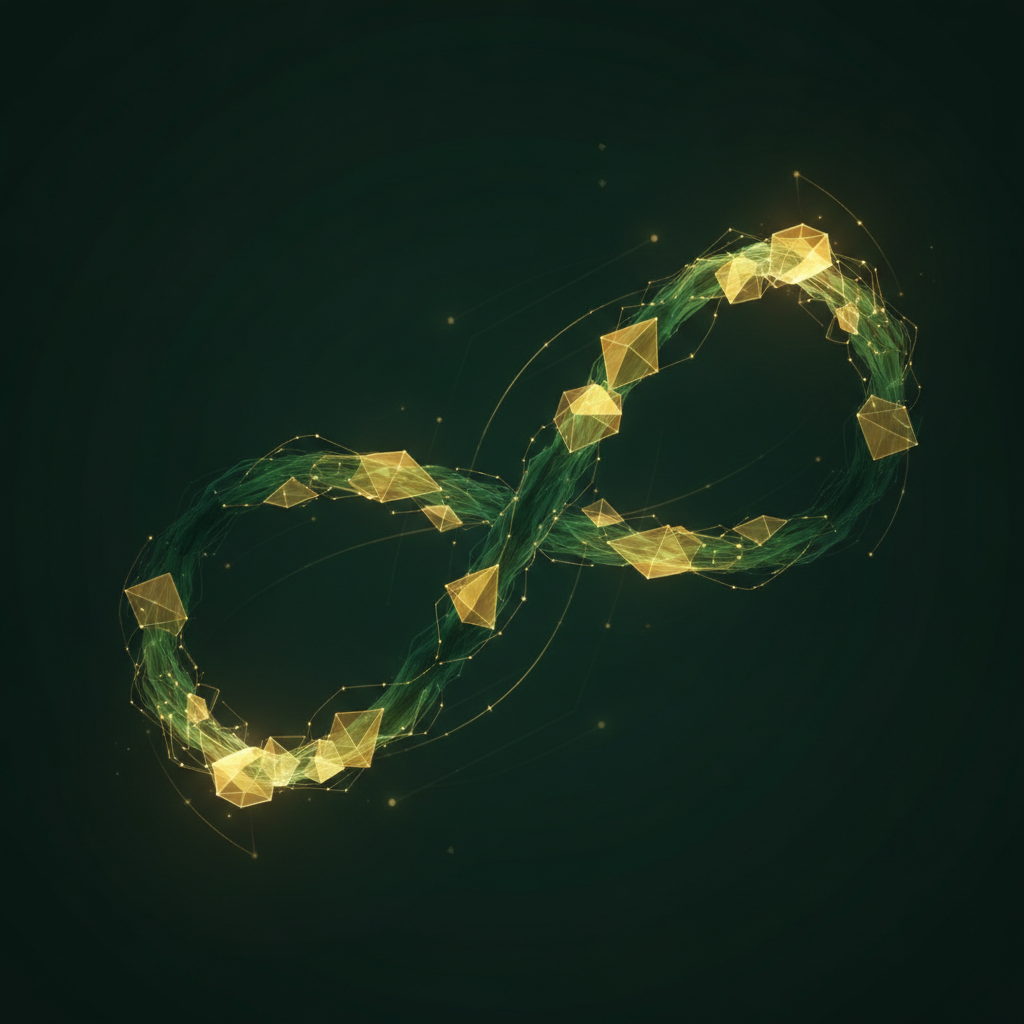
The Mobius coil represents a fascinating intersection of topology and electromagnetic theory, finding a unique application within the field of orgone energy technology, particularly in devices developed by Karl Hans Welz. Its distinctive geometry and winding configuration are theorized to interact with subtle energy fields in ways that differ significantly from conventional electrical coils. This article delves into the physics behind the Mobius coil and its specific role in orgonic devices, such as Welz’s notable Succor Punch.
What is a Mobius Coil in Orgonic Devices?
A Mobius coil, in the context of orgonic devices, is an electrical coil wound in a configuration that mimics the topological properties of a Mobius strip. According to Welz’s framework, this unique winding is theorized to create a non-inductive field, allowing for a distinct interaction with orgone energy compared to standard electromagnetic coils.
The fundamental concept of a Mobius strip is a surface with only one side and one boundary component. When applied to coil winding, this typically involves taking a strip of material, twisting one end 180 degrees, and joining it to the other end. For an electrical coil, this principle is translated into winding two wires in opposite directions, often in parallel, and connecting them in a specific way that results in a self-canceling magnetic field. This non-inductive characteristic is central to its proposed function in orgone technology, as it suggests an interaction that bypasses conventional electromagnetic principles.
The Unique Geometry and Winding of the Mobius Coil
The unique geometry of the Mobius coil is achieved by winding two conductors in a bifilar (side-by-side) fashion, but with a specific cross-connection that creates a topological twist. This winding technique aims to cancel out the conventional magnetic fields that would normally be generated by current flowing through a standard coil.
In practice, two insulated wires are often laid parallel to each other and then wound together onto a core. The critical step involves connecting the start of one wire to the end of the other, and vice-versa, or by creating a continuous loop with a 180-degree twist before connecting the ends. This arrangement means that current flowing in one direction through one wire is immediately opposed by current flowing in the opposite direction through the adjacent wire, theoretically leading to a near-zero net magnetic field. This ‘non-inductive’ property is what Karl Hans Welz and other researchers in the field believe allows the coil to interact more directly with orgone energy, rather than generating or being dominated by conventional electromagnetic induction.
Theoretical Implications for Orgone Energy
According to Welz’s theory, the Mobius coil’s unique electromagnetic properties are believed to interact with and influence orgone energy flows by minimizing conventional electromagnetic interference. This non-inductive characteristic is thought to create an environment more conducive to the subtle, non-Hertzian aspects of orgone energy.
Traditional electromagnetic coils generate strong, localized magnetic fields that are well-understood within classical physics. However, the Mobius coil, by theoretically canceling its own magnetic field, is postulated to operate on a different principle. Welz’s framework suggests that this cancellation creates a unique energetic signature or a ‘zero-point’ field that is not easily measurable by standard electromagnetic instruments. It is within this non-conventional field that the Mobius coil is theorized to interact with orgone energy, potentially harmonizing, directing, or amplifying its flow without introducing significant electromagnetic noise. This aligns with the concept that orgone energy is a pervasive, non-electromagnetic life force, requiring specialized interfaces for interaction.
The Mobius Coil in Karl Hans Welz’s Succor Punch
The Mobius coil is a central component in Welz’s Succor Punch, where it is theorized to facilitate the device’s specific orgone energy functions, particularly in generating and directing subtle energetic influences. Its integration is key to the device’s purported capabilities.
The Succor Punch, as described by Karl Hans Welz, is an orgone energy device designed for specific applications, often involving the generation of particular orgone fields or the influencing of consciousness, according to Welz’s theory. Within this device, the Mobius coil is typically embedded within a matrix of transparent casting resin and metal particles, forming the orgonite composite. This combination is crucial: the orgonite itself is theorized to accumulate and convert stagnant orgone energy (DOR) into a more vital form (OR), while the Mobius coil, often connected to a Chi Generator® device, provides a structured pathway or field for this converted energy. The Chi Generator® device provides the driving force, typically a pulsed low-frequency signal, which is then modulated or shaped by the Mobius coil’s unique properties, allowing for the generation of highly specific orgone energy emissions or fields.
Wire Gauge, Materials, and Construction Considerations
The specific wire gauge, material (typically copper), and precise winding technique are critical for the Mobius coil’s intended function in orgonic devices, influencing both its electrical characteristics and its theoretical interaction with subtle energies.
The choice of wire material, almost universally copper due to its excellent conductivity, is fundamental. The gauge of the wire (its thickness) affects its resistance and current-carrying capacity, which in turn influences the electrical characteristics of the coil when driven by a Chi Generator® device. Finer gauges allow for more turns in a smaller space, potentially increasing the length of the wire and thus the total surface area interacting with the surrounding orgonite matrix. The winding technique itself demands precision; maintaining consistent tension and ensuring the bifilar strands are truly parallel and twisted correctly are paramount to achieving the desired non-inductive properties. Any deviation could introduce conventional electromagnetic inductance, potentially diminishing the coil’s unique interaction with orgone energy. Furthermore, the insulation of the wires must be robust to prevent short circuits, especially when embedded in transparent casting resin, which acts as both a binder and a dielectric component in the orgonite matrix.
Distinguishing Mobius Coils from Standard Inductors
Unlike standard inductors designed to create strong magnetic fields for energy storage or filtering, Mobius coils are theorized to minimize conventional electromagnetic induction, creating a different interaction with subtle energy fields.
The distinction lies primarily in their intended function and theoretical electromagnetic profile. Standard inductors are fundamental components in electronics, used for filtering, energy storage, and creating resonant circuits by exploiting their ability to generate and store magnetic fields. Their performance is quantified by inductance (measured in Henrys). Mobius coils, conversely, are designed to negate this conventional inductive property. According to Welz’s theory, this self-cancellation of magnetic fields allows them to interact with non-Hertzian or subtle energy fields, such as orgone, without the dominant electromagnetic signature of a standard coil. This makes them unsuitable for typical electronic applications where inductance is desired, but theoretically ideal for specific orgone energy applications.
| Feature | Standard Inductor Coil | Mobius Coil (in Orgonic Devices) |
|---|---|---|
| Primary Function | Generate and store magnetic fields; filter, tune circuits. | Theorized to interact with orgone energy; minimize conventional EM fields. |
| Magnetic Field | Strong, measurable, localized magnetic field. | Theoretically near-zero net magnetic field due to cancellation. |
| Inductance | High, measurable inductance (Henrys). | Theoretically very low or negligible inductance. |
| Winding | Single wire, or multiple wires in series/parallel for specific inductance. | Bifilar winding with specific topological twist for field cancellation. |
| Energy Interaction | Interacts with electromagnetic energy. | Theorized to interact with subtle, non-Hertzian orgone energy. |
| Application | Power supplies, radios, filters, motors. | Orgone energy devices (e.g., Welz’s Succor Punch, Chi Generator devices). |
Related Reading
- The Succor Punch: Orgone Technology for Manifestation
- Understanding the Chi Generator®: Orgone Energy Devices
- What is Orgone Energy? A Comprehensive Overview
- Karl Hans Welz: Inventor of Orgonite and Pioneer of Orgone Technology
Orgonite and orgone energy devices are presented as tools for energy balancing and spiritual wellness. They are not intended as replacements for medical treatment. Consult a qualified healthcare professional for any health-related decisions.