
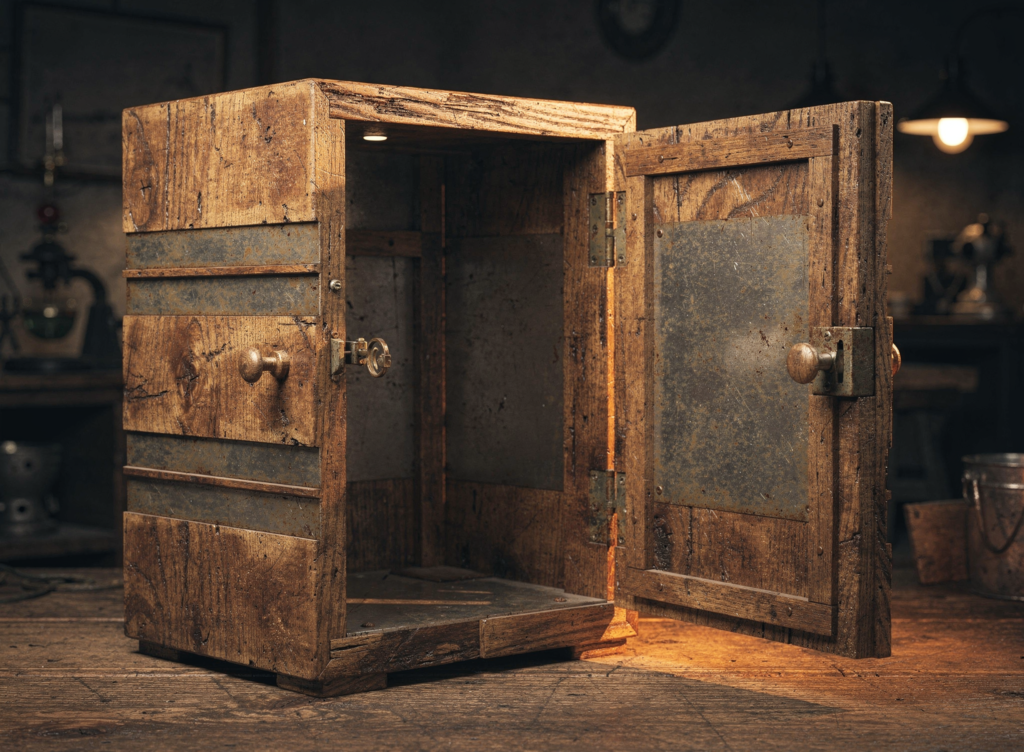
The orgone accumulator is one of the most important and misunderstood devices in the history of alternative energy research. Developed by Wilhelm Reich in the 1940s, it was the direct predecessor to orgonite — and understanding how it works helps explain why Karl Hans Welz’s invention was such a significant step forward. This guide covers everything you need to know about the orgone accumulator: what it is, how it works, how it differs from orgonite, and how to use one.
Who Invented the Orgone Accumulator?
Wilhelm Reich, the Austrian-American psychiatrist and researcher, developed the orgone accumulator in the early 1940s following his discovery of what he called orgone energy — a universal life-force energy present in all living matter and in the atmosphere. Reich observed that certain materials attracted and held orgone energy, while others repelled it. Organic materials — wood, cotton, wool — attracted orgone. Metallic materials repelled it. This observation led directly to the design of the accumulator.
How Does the Orgone Accumulator Work?
The orgone accumulator is built on a simple but specific principle: alternating layers of organic and metallic materials create a directional flow of orgone energy. The organic layer on the outside attracts orgone from the environment. The metallic layer on the inside reflects it inward. By stacking multiple alternating layers, the accumulator effect is amplified — more layers produce a stronger concentration of orgone energy within the device.
The most common form Reich developed was a cabinet large enough for a person to sit inside. The walls consisted of alternating layers of wood and steel wool or sheet metal. A person sitting inside would be exposed to a concentrated field of orgone energy, which Reich believed could support biological vitality and healing processes.
What Are the Different Types of Orgone Accumulator?
Reich developed several forms of the accumulator over his career. The standard cabinet accumulator — a seated enclosure — was the primary therapeutic device. He also developed shooter tubes: metal-lined flexible cables that could direct concentrated orgone energy toward a specific part of the body. Blankets made of alternating organic and metallic layers were another form, used for wrapping around the body. Smaller box-form accumulators were developed for objects such as water or food, which Reich believed could be energetically charged by exposure to the concentrated field.
Orgone Accumulator vs Orgonite: Key Differences
The orgone accumulator and orgonite are related but distinct technologies. The accumulator uses large, discrete alternating layers — wood panels and metal sheets — to create a directional concentration of orgone energy. It is a passive device that works by accumulation: drawing in and holding orgone from the surrounding environment.
Orgonite, invented by Karl Hans Welz in 1992, works differently. The alternation of organic and inorganic material happens at a microscopic level throughout a solid matrix of resin and metal shavings. The addition of a quartz crystal — Welz’s key innovation — introduces a piezoelectric element that actively cycles the orgone field rather than simply accumulating it. The result is a device that is smaller, portable, and continuously active rather than passively concentrative.
Can You Build an Orgone Accumulator at Home?
Yes — the construction of an orgone accumulator is relatively straightforward. The basic requirement is alternating layers of organic and metallic material. A simple shooter tube can be made from a metal pipe lined with organic material. A blanket accumulator can be constructed from alternating layers of steel wool and wool or cotton fabric, sewn together and handled carefully to avoid contact with the steel fibres.
A cabinet accumulator requires more effort: a wooden frame with interior walls made from alternating panels of wood and sheet metal. Reich specified that at least three alternating layers should be used for therapeutic work, with more layers producing a stronger effect. The device should be kept away from sources of radioactivity and from DOR — stagnant or negatively charged orgone — which Reich believed the accumulator could concentrate along with healthy orgone.
Important Cautions
Reich warned that orgone accumulators should not be used near sources of radioactivity or in areas with high concentrations of DOR — which he associated with emotional stagnation, industrial pollution and electromagnetic contamination. He observed that accumulators could concentrate whatever orgone was present in the environment, which made environmental quality an important consideration.
This is one area where orgonite offers a practical advantage: it is designed to transform DOR into positive orgone rather than simply accumulate whatever is present. For use in modern electromagnetic environments, many researchers consider orgonite to be safer and more appropriate than the classical accumulator.
The Orgone Accumulator Today
Interest in the orgone accumulator has persisted since Reich’s death in 1957. The Wilhelm Reich Museum in Rangeley, Maine, maintains his original laboratory and several of his accumulator devices. Researchers and practitioners continue to build and use accumulators for personal and experimental purposes. The device remains the historical foundation from which all subsequent orgone technology — including orgonite — developed.
Understanding the accumulator is essential context for understanding why Welz’s invention of orgonite represented such a significant advance: it took Reich’s principle of organic/inorganic alternation and made it continuous, portable, and actively cycling rather than passively accumulative.
Related articles: Orgone Accumulator vs Orgonite: What’s the Difference? — Wilhelm Reich: The Man Behind Orgone Energy — What is Orgonite and How Does It Work?